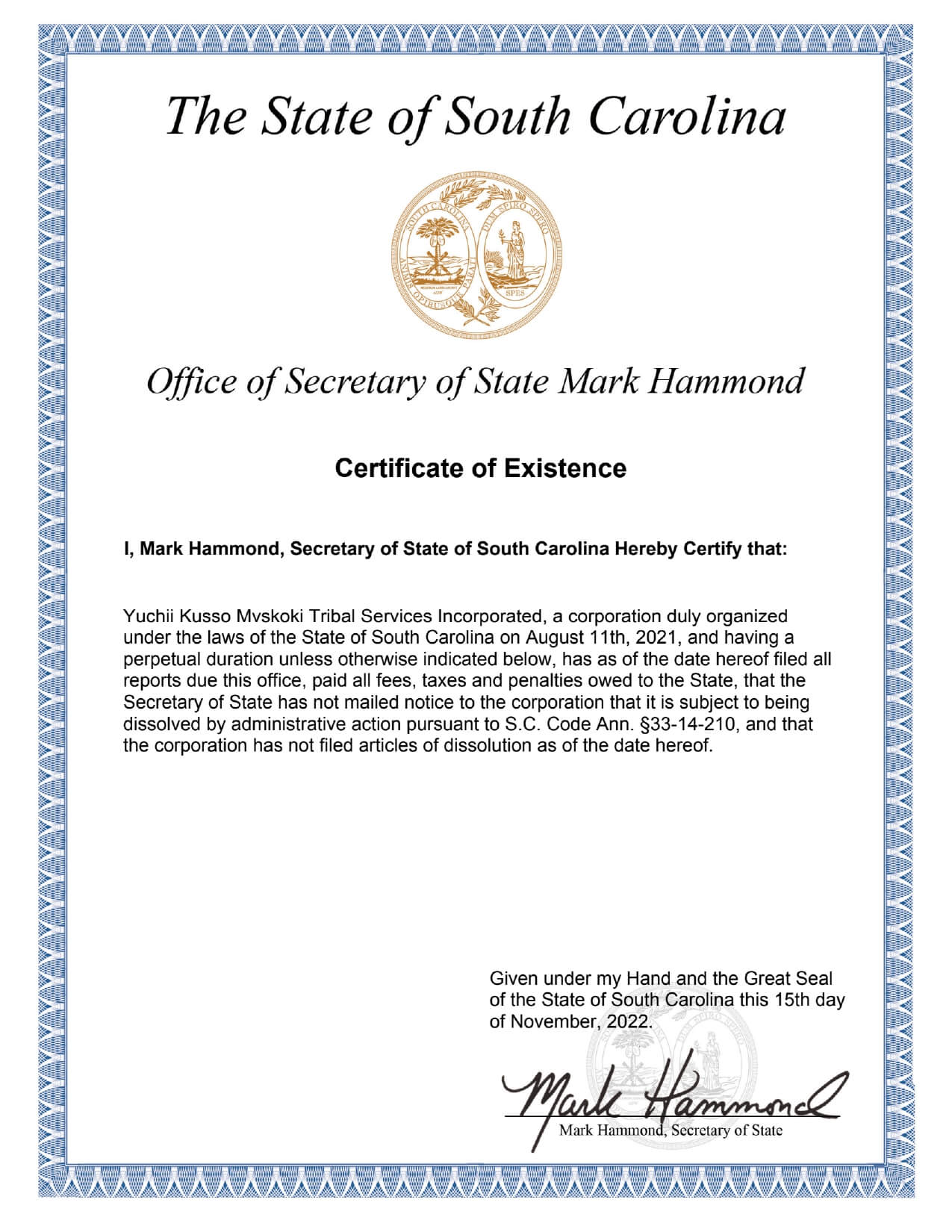
Formation and Administration
YUCHII KUSSO MVSKOKI TRIBAL COUNCIL | GOVERNMENT
A Declaration of Inherent Indigenous Self-Government, Cultural Restoration, and
Community Administration
|
ADOPTED BY |
Citizens and Tribal Council |
|
ADOPTION DATE |
March 19, 2019 |
|
EFFECTIVE DATE |
August 12, 2021 |
|
PRINCIPAL OFFICE |
Chief Atali Yuchii (Chief Executive) |
FOUNDATION DECLARTION
The Yuchii Kusso Mvskoki Tribal Council declares that its Indigenous identity, existence as a people, and inherent right of self-government were neither created by the United States nor granted by any European power. The Council affirms that its people and ancestors existed on the land now called the United States before European colonization and maintained relationships with their ancestral homelands, families, communities, culture, spirituality, and traditions before any outside government claimed authority over them or created a system for recognizing Indigenous peoples.
The Council further declares that colonization, enslavement, racial reclassification, forced assimilation, displacement, and suppression of Indigenous languages and customs harmed the identity and continuity of Indigenous peoples. The Council identifies its ancestors and people within a historical tradition it describes as Copper-Colored Indians and rejects the erasure of that identity.
Accordingly, the Yuchii Kusso Mvskoki Tribal Government is established and continued as an act of restoration and continuity, not as a request for permission to exist. Its central responsibilities are to protect the people, restore culture and language, preserve genealogy and history, administer the community responsibly, and carry this inheritance forward for future generations.
Legal Status, Reserved Claims, and Purpose
These records affirm the Council’s declaration of inherent Indigenous identity, peoplehood, sovereignty, and self-government. Nothing in this Manual abandons, waives, limits, or surrenders any claim concerning ancestral land, property, money, resources, unpaid deposits, compensation, restitution, or other relief that the Council or its citizens may assert was wrongfully taken, withheld, lost, mismanaged, or denied.
The Council expressly reserves the right to investigate, document, present, and pursue claims for the return or restoration of ancestral lands and for a full accounting and recovery of funds or property owed to its people or their ancestors. Claims may concern slavery, dispossession, forced removal, destruction of identity and culture, uncompensated labor, discriminatory governmental action, and deposits or other property lost through the failure or mismanagement of the Freedman’s Savings and Trust Company, commonly known as the Freedman’s Bank. The Council may seek land, monetary compensation, restitution, an accounting, or other appropriate remedies from any government, institution, entity, lawful successor, or other source shown by historical, genealogical, financial, or legal evidence to bear responsibility.
Under the present United States legal system, courts, legislatures, agencies, and governments determine whether they will recognize, consider, or enforce a particular claim or governmental power. Adoption of this Manual does not place the Council on the federal list of recognized Indian tribes, create federal trust land, establish eligibility for federal Indian programs, or guarantee outside acceptance of a claim involving immunity, taxation, territorial jurisdiction, police authority, or regulatory authority. These limitations do not extinguish the Council’s position, bar it from seeking relief, or constitute consent to the taking or continued withholding of its land, property, money, identity, or rights.
Nothing in this Manual asks an outside government to create, grant, or define the Council’s Indigenous identity or inherent sovereignty. The Manual states the Council’s position, preserves claims and remedies, protects the Council and its citizens, and distinguishes the Council’s declaration of inherent sovereignty from the separate question of recognition or enforceability under current United States law.
Article I – Formation and Purposes
Section 1. Declaration of formation
We, the citizens and descendants of the Yuchii Kusso Mvskoki people, united by ancestry, kinship, history, homeland, culture, and responsibility to future generations, establish and continue this Tribal Council and government. We declare an inherent right to preserve our community and govern our voluntary internal affairs. We form this government to repair historical erasure, protect the truth of our families, and carry our identity forward with dignity, discipline, and accountability.
Section 2. Governmental purposes
- Preserve and revitalize Indigenous identity, language, history, spirituality, and culture.
- Maintain accurate citizenship and genealogical records under fair, documented standards.
- Provide orderly systems of leadership, elections, meetings, lawmaking, administration, and accountability.
- Promote the health, education, safety, economic security, and general welfare of citizens.
- Protect burial places, sacred knowledge, cultural property, archives, and historically significant lands.
- Represent the collective interests of the people and maintain respectful relationships with governments and institutions.
- Seek justice, restitution, restoration, protection of rights, and other lawful remedies when duly authorized.
- Protect future generations from renewed loss, exploitation, and misrepresentation.
Article II – Identity, Sovereignty, and Present Legal Position
Section 1. Inherent sovereignty
The Council declares that sovereignty is inherent in the people and is not a gift from another nation. Leadership authority flows from the citizens, the Constitution, Council laws, and responsibilities inherited from the ancestors.
Section 2. Present recognition status
The Council shall state accurately that it is not included on the United States list of federally recognized Indian tribes. It does not seek federal recognition as the source or objective of its sovereignty. The Council does not claim that treaties made with federally recognized Indian tribes apply to the people it identifies as Copper-Colored Indians, and it does not seek inclusion under those treaties. This position is not a surrender of the Council’s historical identity, reserved claims, or declaration of inherent sovereignty.
Section 3. Exercise of internal authority
The Council shall govern its voluntary internal affairs to the fullest extent permitted by applicable law, including citizenship, elections, leadership, culture, internal discipline, community property, records, voluntary dispute resolution, contracts, and organizational programs.
Section 4. Assertions affecting outside parties
Before asserting authority concerning land, nonmembers, taxes, courts, law enforcement, regulated businesses, sovereign immunity, or another matter affecting outside parties, the Council shall obtain written advice from a person or a qualified attorney. Officials shall not issue credentials that imitate federal, state, or local identification or imply powers not legally established.
Section 5. No waiver of identity
Compliance with applicable law, use of a state-law entity, an application submitted to an outside body, or acceptance of a grant shall not be interpreted internally as an admission that the Council’s identity began with that law, entity, application, or grant.
Section 6. Doctrine of Discovery and Indigenous rights
The Council takes notice of the March 30, 2023 Joint Statement of the Dicastery for Culture and Education and for Promoting Integral Human Development. That statement repudiates the legal and political concept commonly called the ‘doctrine of discovery’ as not part of Catholic Church teaching; acknowledges suffering caused by the expropriation of Indigenous lands and forced assimilation; and recognizes the inherent dignity and rights of Indigenous peoples. It also acknowledges that certain papal documents were manipulated by colonial powers to justify immoral acts and cites the 1537 papal bull Sublimes Deus, which opposed depriving Indigenous peoples of liberty or property and opposed their enslavement. The Council understands these acknowledgments as rejecting the use of Catholic authority as a moral or religious justification for taking Indigenous lands, enslaving Indigenous peoples, coercing them, or destroying their cultures. Consistent with the Council’s historical account, this includes harms suffered by ancestors whom the Council identifies as Copper-Colored Indians. These statements offer historical and moral support for Indigenous dignity, property, identity, language, and culture; they do not, by themselves, decide title to a particular parcel or determine the Council’s present legal status under United States law.
Article III – Foundational Governing Documents
The Council shall adopt and maintain the following documents as needed:
- Constitution or governing charter
- Formation and adoption resolution
- Citizenship ordinance
- Election ordinance
- Financial-management policy
- Records and archives policy
- Cultural-protection and language-restoration policy
- Meeting and parliamentary procedures
- Grievance and appeals procedure
- Administrative code
- Historical documentation and claims-research plan
- Seal, insignia, and identification policy
Section 1. Order of authority
For internal administration, authority shall be applied in the following order: applicable enforceable law; the Constitution; citizen-approved amendments; ordinances; resolutions; and administrative regulations and policies. This administrative order does not negate the Council’s declaration of inherent sovereignty or reserved claims.
Article IV – Citizenship
Section 1. Eligibility
Citizenship shall be based on documented descent, kinship, community continuity, and criteria adopted in the Citizenship Ordinance. Standards shall be applied consistently and shall not be changed to favor or exclude particular families for political reasons.
Section 2. Evidence
The Citizenship Committee may consider reliable evidence appropriate to the historical circumstances, including:
- Birth, death, and marriage records.
- Federal and state census records.
- Church, school, military, cemetery, probate, and land records.
- Historical rolls, community records, family Bibles, photographs, and correspondence.
- Oral histories and affidavits, particularly when colonization or discrimination caused gaps in official records.
- DNA evidence as supporting evidence only, never as the sole definition of cultural or political citizenship.
Section 3. Committee review and appeals
A Citizenship Committee shall review applications confidentially, disclose conflicts of
interest, and issue written decisions. A denied applicant may appeal within thirty days to an impartial appellate body, which shall decide the matter under the Citizenship Ordinance and the record presented.
Section 4. Identification notice
Council citizenship cards shall truthfully identify the issuing body and its present recognition status. They shall not be represented as federal identification or as independent proof of eligibility for federal Indian benefits.
Article V – Structure of Government
Section 1. General Citizenship Assembly
The General Citizenship Assembly consists of eligible voting citizens and is the source of delegated governmental authority. It elects leaders, approves constitutional amendments, receives annual reports, and exercises powers reserved to the people.
Section 2. Tribal Council
The Tribal Council may include the following offices, as defined by the Constitution:
- Chief Administrator or Principal Chief
- Vice Chief or Deputy Administrator
- Council Chairperson
- Secretary
- Treasurer
- Council Representatives
- Elders’ Representative, if established
- Youth Representative, who may be nonvoting
Section 3. Departments
The Council may establish departments for citizenship and genealogy; culture and language; education; health and human services; economic development; historic preservation; finance and grants; communications; elders and youth; land and environment; and historical or claims research.
Section 4. Internal Review Tribunal
An Internal Review Tribunal may hear citizenship appeals, election challenges, ethics matters, and voluntary disputes arising under Council law. It shall not be represented as a federal or state court. Its authority over a person shall rest on citizenship, consent, contract, or another legally supportable basis.
Article VI – Powers and Duties of the Council
- Adopt ordinances, resolutions, regulations, and policies.
- Manage Council property, finances, staff, programs, and archives.
- Enter lawful contracts and retain qualified professional advisers.
- Operate cultural, charitable, educational, and community programs.
- Establish lawful nonprofit, business, trust, or other entities when useful.
- Advocate before governments, institutions, and the public.
- Conduct historical, genealogical, linguistic, archaeological, land, and claims research.
- Protect the Council’s name, seal, records, traditional knowledge, and intellectual property.
- Seek the return, protection, access, or respectful treatment of cultural items, burial places, and historic sites through lawful processes.
Article VII – Officers
Section 1. Chief Administrator or Principal Chief
Serves as principal executive officer; carries out Council law; supervises authorized departments; represents the government in approved matters; presents an annual report; and signs authorized agreements.
Section 2. Vice Chief
Assists the Chief and acts during the Chief’s absence, disability, removal, or vacancy, as provided by the Constitution.
Section 3. Secretary
Maintains minutes, laws, resolutions, correspondence, election records, notices, and government archives.
Section 4. Treasurer
Maintains financial records; prepares budgets and reports; safeguards deposits and payments; coordinates required filings, reviews, or audits; and reports suspected financial misconduct.
Section 5. Limits on authority
No officer may spend Council funds or bind the Council to a contract without documented authority.
Article VIII – Elections, Terms, Vacancies, and Removal
- Regular elections shall occur every four years.
- Voting shall be by secure secret ballot unless the Constitution authorizes another method.
- Candidates must be adult citizens in good standing and satisfy published qualifications.
- An independent Election Committee shall administer elections and preserve election records.
- Candidates may request recounts or file challenges under the Election Ordinance.
- An official may be removed for serious misconduct, neglect of duty, misuse of funds, abuse of authority, or substantial violation of the Constitution, but only after notice and a fair hearing.
- Vacancies shall be filled under the Constitution and any duly adopted succession policy.
Article IX – Meetings and Lawmaking
Section 1. Meetings and quorum
The Tribal Council shall meet at least quarterly. The General Citizenship Assembly shall meet at least annually to receive leadership, financial, cultural, and departmental reports and to conduct election business when applicable. Unless the Constitution requires a greater number, a majority of seated Council members constitutes a quorum.
Section 2. Emergency action
Emergency meetings may address immediate threats to people, records, property, finances, health, safety, or governmental continuity. Emergency authority shall not be used to make permanent constitutional changes or avoid citizen oversight.
Section 3. Ordinances and resolutions
An ordinance establishes a continuing rule. A resolution records a particular decision, authorization, appointment, or statement. Major proposed ordinances should be written, numbered, noticed, discussed at a lawful meeting, voted upon, signed, and entered in the official law register.
Article X – Ethics and Accountability
- Act in the best interests of the people.
- Protect confidential, sacred, genealogical, medical, personnel, and financial information.
- Disclose financial and family conflicts and recuse when materially conflicted.
- Avoid favoritism, nepotism, retaliation, and misuse of office.
- Never use Council property or funds for unauthorized personal benefit.
- Treat citizens fairly and describe the Council’s status and authority truthfully.
- Permit good-faith complaints without retaliation.
- An Ethics Committee may investigate written complaints and recommend corrective action after giving the affected person notice of the allegations, reasonable access to the evidence, and an opportunity to respond.
Article XI – Financial Administration
- Adopt an annual budget.
- Use accounts held in the correct legal name.
- Require documented approval and appropriate separation of financial duties.
- Issue receipts for payments, donations, and fees.
- Reconcile accounts monthly.
- Preserve invoices, contracts, bank records, grant records, and supporting documents.
- Maintain an inventory of Council property.
- Provide annual financial reports to citizens.
- Arrange an independent financial review or audit when appropriate.
The Council may organize a nonprofit corporation or other lawful entity to receive grants, hold property, employ staff, or operate programs. The entity’s legal status, liabilities, governance, and tax obligations shall be documented separately from the Council’s declaration of inherent sovereignty.
Article XII – Records, Genealogy, and Archives
The Council shall preserve citizenship files, genealogies, oral histories, minutes, laws, election records, contracts, financial records, cultural materials, maps, photographs, land records, and claims research. The Council shall index original materials, digitize them as appropriate, protect them from damage, and back them up in more than one secure location.
Access rules shall protect privacy and sacred knowledge while permitting responsible research. No person may alter, destroy, conceal, sell, or remove an official record without written authority.
Article XIII – Cultural, Language, and Identity Restoration
Cultural restoration is a primary governmental responsibility. The Council shall support language reconstruction and teaching, oral-history collection, traditional arts, ceremonies, youth education, elders’ knowledge, historic-site protection, and respectful care of burial places and cultural items.
The Council shall establish standards governing the use of its name, identity, seal, stories, images, traditional knowledge, and sacred materials. No official may sell, publish, license, or disclose restricted cultural knowledge without approval from Council law and the cultural authority.
Historical research shall be rigorous and transparent. The Council may state its traditions and conclusions while distinguishing among primary-source evidence, oral tradition, interpretation, matters still under investigation, and positions disputed by outside institutions.
Article XIV – Historical Documentation and Claims Strategy
Consistent with Article II, the Council may pursue protection of land and property interests, an accounting, restitution, restoration, legislation, litigation, agreements, or other lawful remedies without treating outside action as the origin of its peoplehood.
Section 1. Historical Documentation Committee
The Historical Documentation Committee shall:
- Document the historical community and the ancestors from whom present citizens descend.
- Collect evidence of continuing community, kinship, leadership, and political influence.
- Create source-cited genealogies and protect the underlying records.
- Document racial reclassification, enslavement, removal, displacement, and other forces that may have obscured Indigenous identity in official records.
- Distinguish verifiable evidence, oral tradition, interpretation, and advocacy so each may be evaluated responsibly.
- Consult historians, genealogists, archivists, linguists, archaeologists, land-record researchers, financial experts, and attorneys when needed.
- Document the historical and legal basis of land, property, banking, restitution, jurisdictional, or other external claims and evaluate available remedies before filing or publicly asserting a claim.
Article XV – Relations with Other Governments and Peoples
The Council may maintain respectful relations with federally recognized tribes, state-recognized tribes, other Indigenous communities, federal agencies, states, local governments, universities, archives, churches, financial institutions, and cultural organizations. No agreement may surrender citizenship authority, cultural identity, archives, land claims, reserved claims, or other fundamental interests without the approval required by the Constitution.
The Council shall pursue truth and restoration without diminishing the identity or history of African peoples, other Indigenous nations, or any other community. Historical claims shall be developed through careful research, respectful dialogue, and preservation of oral and documentary evidence.
Article XVI – Amendments
An amendment requires a written proposal, notice to eligible voters, an opportunity for discussion, the vote required by the Constitution, certification of the result, and entry in the official record. No administrative policy may amend the Constitution.
Article XVII – Continuity and Dissolution
If an associated entity formed under state or federal law dissolves, its property shall be handled under applicable law and its governing documents. Cultural, genealogical, and historical records shall pass to a responsible successor or protected archive, subject to Council confidentiality rules. Dissolution of a corporation or other legal entity does not by itself dissolve the people, their kinship, their cultural identity, or their reserved claims.
Formation and Adoption Resolution
Resolution No. 87-2166987
A RESOLUTION ESTABLISHING AND CONTINUING THE YUCHII KUSSO MVSKOKI TRIBAL COUNCIL
WHEREAS, the citizens declare that their Indigenous identity, ancestry, and relationship to this land predate European colonization and were not created by an outside government; and
WHEREAS, the citizens declare that colonization, enslavement, racial reclassification, displacement, and forced assimilation caused loss and suppression of identity, language, heritage, and culture; and
WHEREAS, the citizens identify within a historical tradition they describe as Copper-Colored Black Indians and seek restoration and protection of their people’s identity and inheritance; and
WHEREAS, the Catholic Church’s March 30, 2023 joint statement repudiated the legal and political ‘doctrine of discovery,’ acknowledged the manipulation of papal documents by colonial powers to justify immoral acts, recognized harms caused by expropriation and forced assimilation, and affirmed the inherent dignity and rights of Indigenous peoples; and
WHEREAS, the citizens desire an accountable government to preserve their heritage, administer citizenship, protect records, pursue properly documented claims and remedies, conduct programs, and serve future generations; and
NOW, THEREFORE, BE IT RESOLVED:
- The Yuchii Kusso Mvskoki Tribal Council is established and continues under its Constitution and this Manual.
- The Council declares that its inherent identity and right of internal self-governance are not created by federal or state recognition.
- The Council shall describe its present legal status accurately and shall not issue misleading credentials or assert externally enforceable powers without a sound legal basis.
- The Council reserves its claims and shall make cultural restoration, language, genealogy, historical truth, responsible claims research, and protection of future generations central governmental responsibilities.
- The interim Council shall establish citizenship records, elections, financial controls, ethics rules, cultural programs, and official archives.
- This Resolution becomes effective upon adoption by the vote required under the governing rules.
COUNCIL MEMBERS
Adopted On: March 19, 2019
Administrator of Tribal Authority
Chief Atali Yuchii
Email: chiefatali1000@gmail.com
Executive of Administration
Chief Hacha Kusso
Email: hachakusso@gmail.com
Executive Secretary
Chief Dahkirah Yuchii
Email: htb.csr@gmail.com
Executive of Treasury
Chief Anli Yuchii
Email: bea_ponytail@yahoo.com
Executive of Agriculture
Chief Dijon Yuchii,
Email: johnwanyeharvey891@gmail.com
Executive of Transportation
Chief Hania Kusso
Email: jamesgillespie322@gmail.com
Representative of the Wateree Tribe
Chief Keturah Mvskoki Wateree,
Email: chiefketurah@gmail.com
Date: September 11, 2026